Vixen
The Jungle BookVixen is the narrator’s little fox terrier and one of the most vivid animal figures in “The Parade Song of the Camp Animals.” She is small enough to be bullied by no one in spirit, bold enough to harry an elephant, loyal enough to search a rain-soaked camp for her master, and vain enough to invent an imaginary dog-cart and stable of horses. Through her, the story turns the military camp into a society of animal voices, where courage, rank, obedience, fear, and human ownership can all be judged from below.
Identity and Introduction
Vixen appears during the violent confusion of the Rawal Pindi military review. Thirty thousand men and thousands of camels, elephants, horses, bullocks, and mules have gathered in continuous rain for the Viceroy of India and the Amir of Afghanistan. At night, the Amir’s unfamiliar horses break their heel ropes, camels run loose, and the narrator’s tent collapses when a camel blunders into it. While the narrator escapes into the mud, Vixen goes out through the opposite side, establishing her independence even in the first crisis.
The narrator later describes her as a “little” fox terrier, a phrase that emphasizes the disproportion between her size and her force of character. She is not presented as a trained military animal or as a decorative pet alone. Her behavior gives her a distinct practical intelligence: she recognizes danger, searches deliberately, bullies a larger animal, and communicates the experience of the night as though it were a report. The story’s animal society therefore grants Vixen perception and judgment rather than treating her merely as human property.
Conduct During the Night
Vixen’s most important action is her search for the narrator after the tent is destroyed. She crosses the camp alone through mud and darkness, eventually finding him near the artillery lines. Her return is marked by physical evidence of the ordeal: she is muddy all over, yet immediately runs to him, licks his nose, and tells him about hunting for him throughout the camp. Her loyalty is active rather than sentimental. She does not wait passively for rescue; she follows the trail of a disrupted human world until she has restored the bond between herself and her master.
Her discovery of the narrator also becomes a comic tactical encounter with Two Tails, an elephant chained in his pickets. Vixen understands that an elephant fears a little barking dog more than almost anything else. She stops to bully Two Tails, yapping around his great feet and threatening his composure without needing to attack him physically. The elephant pleads with her to go away and worries that she will bite his ankles. Vixen’s smallness, far from making her helpless, gives her a form of mobility and psychological leverage that the enormous animal lacks.
When the narrator whistles, Vixen runs to him and resumes her place beside him. He conceals her inside the breast of his overcoat, a practical act of protection that also shows their intimacy. From there she remains close while Two Tails searches anxiously with his trunk. Vixen’s movements thus shape the scene twice: first as an independent searcher in the dark, then as a hidden presence whose absence unsettles the elephant.
Voice, Vanity, and Social Judgment
Vixen possesses a conspicuously boastful voice. While speaking with the troop-horse, she claims that she and her master keep scores of horses, although the narrator identifies these stories as lies. Her conceit is not malicious; it is a comic performance through which she adopts the social language of military ownership and display. She imagines herself arriving at the next day’s parade in a dog-cart and asks the troop-horse where he will be positioned, treating him as an acquaintance whose official duties matter to her.
Her vanity contrasts with her genuine bravery. She boasts about horses but has actually faced the night, crossed the camp, and driven Two Tails into panic. The contrast makes her more than a simple comic pet. Vixen’s exaggerations reveal a lively animal ego, while her conduct supplies the evidence that the ego is not entirely false: she really is bold, resourceful, and socially confident. The story allows her self-invention to coexist with dependable action.
Vixen also participates in the camp’s informal hierarchy. She identifies herself as being cared for by a white man, and the surrounding animals interpret this as a sign of status. Her remarks therefore connect private attachment with imperial organization: she is both an individual companion and an animal situated within a human military structure. Yet she does not speak like a silent possession. She boasts, negotiates, insults, and evaluates, making the supposedly subordinate animal a commentator on the system around her.
The Parade and Its Meaning
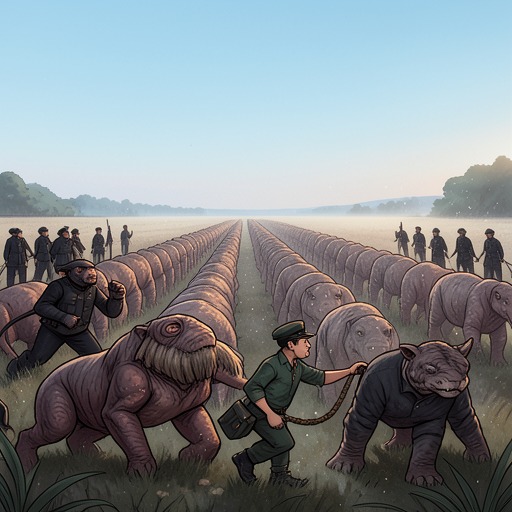
The next afternoon, Vixen and the narrator secure a good place near the Viceroy and the Amir. From that position she watches the enormous machinery of the review: infantry moving in waves, cavalry passing to the sound of “Bonnie Dundee,” guns aligned in formation, elephants harnessed to a forty-pounder siege gun, oxen following behind, and the screw guns arriving with Billy the Mule carrying himself like a commander. Vixen’s presence links the private adventure of the night to the public spectacle of military order.
The troop-horse whom Vixen had met in the darkness now performs with exact discipline, setting the time for his squadron. The contrast is revealing. At night, animals speak of fear, irritation, vanity, and uncertainty; by day, they become parts of a precise formation before imperial authority. Vixen remains a small individual observer beside the narrator, while the larger animals are absorbed into lines of cavalry, artillery, and transport. Her perspective preserves the personal and comic scale that the parade suppresses.
The review ends with a striking explanation of collective obedience. An old Central Asian chief asks how such a vast and complicated display has been achieved, and a native officer answers that an order was given and obeyed. Vixen’s story has already shown the limits behind that principle: a camel can panic, an elephant can fear a barking dog, and a little terrier can ignore the apparent hierarchy of size. Her role makes the parade’s polished obedience look like a surface imposed over many separate animal temperaments.
Narrative Role and Significance
Vixen functions as companion, scout, comic trickster, and witness. Her loyalty gives the night episode its emotional center, while her harassment of Two Tails supplies its sharpest reversal of power. She also helps the narrative cross the boundary between human and animal knowledge: the narrator understands beast speech but keeps that ability secret, and Vixen’s conversation becomes part of a hidden social world that humans ordinarily cannot hear.
Her character is built from a productive tension between dependence and agency. She belongs to the narrator, travels under his protection, and is eventually buttoned into his overcoat; nevertheless, she chooses to search for him, decides to bully Two Tails, invents her own prestige, and speaks with confidence about the parade. Vixen therefore embodies the book’s recurring animal-centered method: creatures may be used, classified, harnessed, or owned by human institutions, but they retain distinct memories, fears, loyalties, and judgments. In the military camp, the smallest voice is not the weakest one; it is often the voice most capable of exposing what the grand formation conceals.